Thursday, March 8, 2012

Lessons from Watts


According to my research, the Watts Riots were caused by a build-up of underlying racial tension between African Americans and the white Anglos. High unemployment, poor public maintenance, lack of convenient public transportation, and other significant social factors all led to the riots.

These aspects of the Watts Riots are well-known and are usually the subjects addressed when discussing the event. However, what's perhaps more interesting and much less known is that the neighborhood actually deteriorated even further after the riots occurred. Despite the various efforts to rejuvenate the district, the citizens of Watts have reported that the area has seen minimal improvement (note that you need to log in to ProQuest to view the webpage).

How could the neighborhood continue to decline in spite of the success of the programs aimed at improving the area? The answer is two-tiered: many of the programs were only short-term solutions, and the citizens who benefited tended to leave Watts as soon as was financially possible. A major problem with many of the projects focusing on contributing to the area's regrowth is that the solutions were only temporary. Improving the streets and public transportation are meaningless if these improvements are not maintained.


Additionally, considering the poor state of the Watts neighborhood, many of the citizens who found employment and financial aid through the new community-based programs left the area once it became financially viable to do so. From their perspective, it would be better to live in a slightly more expensive area if that meant escaping the poor conditions of Watts.

What can be learned? The answer is long-lasting solutions to underlying social problems. Had the programs and projects aimed at helping the Watts district simply maintained their efforts, the neighborhood would have avoided further decline. Although continuing these programs may cost more, the payoff would be worth the money considering the consequences are widespread unrest and eventual rioting.

Wednesday, February 29, 2012

The Watts Riots 1965


The Watts Riots of 1965 was a reaction against racism and segregation that lasted for 5 days from August 11 - August 15. The Riots started when police officers pulled over a car driven by an African-American man under the pretenses of drunk driving. A crowd began to grow around the officers, and in response they called for backup. This led to a series of events which ended with five days of rioting, looting, and vandalism.


Obviously the tensions that started the rioting and looting stem deeper than someone being arrested for drunk driving. Considering Watts had been suffering long before as a result of high unemployment, high rates of crime, poor maintenance and public transportation, etc., its no surprise that so much violence eventually occurred (especially considering the major reason for Watts' condition was racism). If anything, the initial premise of the riots is inconsequential: the tensions building up to the riots could have easily occurred before or after the starting incident.

The amount of damage caused by the Watts Riots stands as one of many testaments to the consequences of racism. However, how do we progress from such violence? Considering the Rodney King riots of 1994 and even the current Occupy movement, what lessons were not learned from the Watts example?

As such, I will be focusing much of my research on what happened before and after the Watts Riots rather than during. What lead to the Watts Riots, and how did the area rebuild? What was efficient at diffusing the tension, and what caused it? In the next post, I will be answering these questions and more, so keep checking for an update!

Saturday, February 11, 2012

What is a Public Space?

In the last post I talked about how Santa Monica Pier acts as a public space. However, what exactly is a public space?

A public space can be described as any place that promotes social interaction by welcoming all members of the community regardless of class or ethnicity. The space should be easy to access and should be safe without prohibiting or preventing people from entering. Additionally, the interests of the overall public should be represented in the public space. Obviously, the public may not agree as to how the space can best serve the community. In such a case, a resolution in which the majority of the public is left satisfied should be reached.

Public spaces should be as welcoming to the public as possible. Therefore, things such as proper facilities, public performances, benches (if outdoors), etc. should be included. There would be no purpose to a public space if it did not attract people to the area.

The problem of safety versus accessibility should also be addressed in a way that satisfies the majority of the public. There have been some instances where, in the interest of safety, certain citizens have been excluded from using a public space. For example, charging people to use a public space would exclude lower class residents from making use of the area. Rather than exclude these citizens, a more effective way to maintain safety while simultaneously welcoming all members of the public would be to hire public security to patrol the area. In fact, such security could even be a part of the attraction of a space.


Recent events have called into question the legitimacy of some public spaces and how "public" they truly are. Specifically, the Occupy movement has sparked debate as to whether or not protesters truly have the right to "occupy" spaces that are considered public. Many protesters have been arrested for occupying spaces that were / are considered public, including those in OccupyLA (which I witnessed firsthand). To my readers, I ask what your opinion is of the issue. Please note that I am only asking for your opinion as to whether or not the protesters have a right to the space; I would like to avoid any political arguments about the 99% versus the 1%. I simply find the debate over the rights of people to public spaces both interesting and relevant.

Sunday, February 5, 2012

Santa Monica Pier


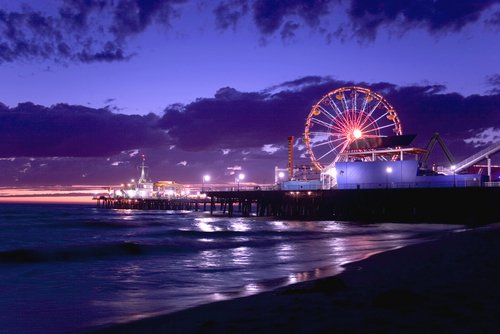
If you ask someone what the essential image of the California Dream is, you will most likely get a response that involves "sunny beaches". To this end, the Santa Monica Pier seems like the quintessential place for the California Dream. As a public space, the pier has done much to be inviting to the general populace as is evident by its history.


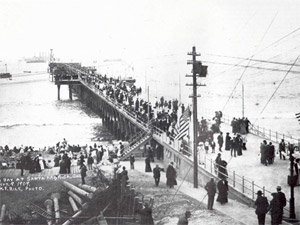
The pier was first opened to the public in 1909. Since its inception, the pier has undergone various transformations, such as the addition of an amusement park in 1916 and a yacht harbor in 1933 (for more information about the various additions / transformations, click here). What's interesting is that the property on which the pier was located was owned privately until it was sold to the city in the early 1970's. When the pier was in threat of being destroyed in favor of building a man-made island resort, the public responded with discontent, eventually causing the plans to be scrapped.

What I find interesting about this bit of history of Santa Monica Pier is the fact that the public felt so strongly about the issue of the resort that they were able to prevent the change from happening. Furthermore, it seems that the Pier has always striven to attract a wide range of people. That is, there doesn't appear to be discrimination against any specific ethnic group or class. From firsthand experience, as well as some reviews which I believe confirm my observation, I believe the pier is truly a public space - that it does not try to exclude any one group of people.

My opinions on the beach as a public space will change as I research more, but for now I would like to ask to any readers your opinions of Santa Monica Pier as a public space. Do you believe the space is truly welcoming to all? If not, why? Any sort of firsthand experiences of visiting the pier would also be appreciated!

Monday, January 30, 2012

New Insights

Although the attack made on the California Dream in "Been to Hell" seems to be typical of music criticizing the fantasy, the lyrics and video introduced concepts concerning the dream which were both insightful and novel. Specifically, the song presented the idea that the disillusionment of the California Dream was universal: that anyone who pursued the dream would ultimately meet with failure. What makes this different from most other songs is that, typically, attacks on the California Dream describe some sort of personal failure. By stating that the falsehood of the fantasy applies to everyone, Hollywood Undead makes a unique critique that questions the validity of the California Dream.

Tuesday, January 24, 2012

"Been to Hell" by Hollywood Undead

The song I chose for my essay is "Been to Hell" by Hollywood Undead. Apart from simply enjoying the band and the music, the reason I chose this song in particular is due to its effective attack on the California Dream. Rather than pretend that the dream can be attained by all who come to Hollywood, the band acknowledges that such a pursuit is more similar to being a "nightmare". Considering all of the music in support of the California Dream (even some from Hollywood Undead itself), it was refreshing to see a song that did not buy in to the advertised ideal.

Been to Hell by Hollywood Undead
Welcome to a city that'll bring you to your knees
It'll make you beg for more, until you can't even breathe
Your blindfold is on tight, but you like what you see
So follow me into the night, cuz I got just what you need
We're all rollin' down the boulevard, full of pimps and sharks
It's a motherfuckin' riot, we've been dying to start
You better grab a hold cuz now you know you're falling apart
You thought these streets were paved in gold
but they're dirty and dark

[Chorus (2x):]
Been to hell!
I can show you the devil!
Down you fell
Can't hold yourself together
Soul to sell
Down here you live forever
Welcome to a world where dreams become nightmares!

Welcome [2x]

[JOHNNY 3 TEARS]
In the belly of the beast, I'm a wolf amongst sheep
At the bottom of the hill, but at the top of the street
Above the boulevard, schoolyard, victim of deceit
And you're running hard, but this wolf it's always at your feet
Yeah you've seen it all before, but the wolf's outside your door
And you're old enough to run, you ain't hiding anymore
Another victim of the star spangled banner of the street
Now you're in the world of the wolves
And we welcome all you sheep

[Chorus]

Welcome [2x]

[CHARLIE SCENE]
You need to wake up and face it
So you can taste my reality
Now you're stuck in this place you hate
And you came here so happily
Then it made you lose your faith
And that's what fucked with your sanity
Say goodbye to your soul and say hello to your vanity
Hollywood is your friend, and the undead are your family
We'll take you to the edge, and turn your regret into agony
And I'll never let you go, cuz I know you'll come back to me
I'm the reason you came here, I'm the American Tragedy

[Chorus]

Welcome [3x]
Welcome to a world where dreams become nightmares!
Welcome

Wednesday, January 18, 2012

The California Dream vs. The American Dream

Unlike the American Dream, which appears to glorify a lifestyle of contentment and strong family values, the California Dream emphasizes a world of fame and fortune. It promises that anyone can rise to super-stardom and live a life where all material desires are satisfied (which is markedly different from simply being content). Although there are many versions of the California Dream, there appears to be some common elements to each interpretation:

- Amazing weather
- Attractive men / women
- High income jobs
- Fame
- Security
- A sense of fulfillment

The most noticeable difference between the American Dream and the California Dream, as evidenced by the list above, is that the former highlights a sense of community and family whereas the latter is more concerned with personal gains. Additionally, it seems that the California Dream panders to young adults - the Dream offers the potential of great success and accomplishment. The American Dream, on the other hand, appeals to those who are looking to "settle down" so to speak - those who are seeking a comfortable, content life rather than one of fame and fortune.

Considering this difference, another major distinction between the American and Californian Dream arises: the success of one's chasing of the dream can be measured in the latter, but not in the former. It would be nearly impossible for one to say whether or not another had truly "accomplished" the American Dream since the ideas it glamorizes, particularly family values and contentment, are subjective in nature. However, since the Californian Dream is concerned with material wealth and gain, success in attaining the dream can be measured by how much wealth and fame one has.

The consequence of this difference is that more people become disillusioned about the California Dream. They realize that the fame and fortune promised only happens to a select few, and even those who do attain those are not necessarily happy. In the next post, I will be presenting a song which I feel embodies this sudden disillusionment.

Until next time, keep living that college dream!
SA