Thursday, April 12, 2012

Speaker Series: Maria Varela

On April 4th, civil rights activist Maria Varela spoke at USC about her experiences with the Civil Rights movement and the struggles she faced. Her comments on what occurred reveal both challenges to and support for the American Dream.

One of the most memorable comments Ms. Varela made concerned the organizing of so many people for a common cause. Obviously, getting together such a wide range of people would be difficult due to differing ideas, personalities, etc. What she emphasized, and what seems to have been a strong point for the Civil Rights movement, was that things always had to be decided on collectively. If the group wanted to present itself in a certain way, the majority had to be supportive of that decision. Furthermore, once the decision was made, everyone had to follow despite what they may believe is a better course of action.

Of course, this did not always go smoothly. Ms. Varela even commented that Dr. Martin Luther King Jr. strayed from these policies at times. However, her experience and overall success as a civil rights activist offers much to be learned to our generation in dealing with the issues of today.

Monday, April 2, 2012

The Recession and the Dream


The economic recession of 2008 has put the American Dream into question for many people. The once possible goal of attaining economic security, a major component of the Dream, has now become seemingly impossible to achieve. For many, this has brought on a sense of disillusionment with the American Dream.

However, I do not believe that this means that Americans have given up on the Dream. Rather, I believe that Americans are fighting for their right to continue pursuing the Dream without impediment. Just because American citizens believe they cannot attain the ideals described by the Dream now does not mean that they think that they will never achieve this goal.

Additionally, I believe that the economic recession has allowed people to come closer together, strengthening community bonds and maintaining the social / cultural aspects of the American Dream. Although the Occupy movement has created a lot of controversy, the movement has also allowed for the public to gather together and rally for a common purpose: to stop corrupt practices in big business and Congress.

What do you believe the recession has had on people's view of the American Dream?

Tuesday, March 27, 2012

The Dream Today: What is It?

The American Dream today cannot be defined as any one ideal or image. Considering the vastly different individuals that comprise the United States, what one citizen's view of the American Dream is will differ from another's. However, there are some generalities that are common for most Americans in their vision of the Dream:
  • Economic Security: Most Americans consider economic security a major component of the American Dream. The ideal would be for families and citizens to have no need for financial concern - money should not be an issue.
  • Cultural: Since there are numerous cultural groups within the U.S., the culture aspect of the American Dream cannot be biased towards any one way of living. Rather, the Dream propagates the idea that people are free to celebrate their own culture without bias or prejudice directed towards them. Furthermore, the Dream suggests that the various cultures within America coexist peacefully and as part of an overall tight-knit community.
  • Political: The political side of the Dream is similar to the cultural component in that Americans should be free to decide their own political / social views without having their opinions attacked or infringed on by others.
I do not believe that the components of the American Dream are exclusive to each other since there is nothing in any one aspect of the Dream that contradicts another. However, I do believe the ideal suggested by the Dream to be realistically impossible to attain. This is because there is no feasible way for everyone to be wealthy and individualistic without coming into conflict with others. Overall, although the future may see a reality closer to the ideal of the Dream, I do not see a way for every citizen to realize the components of the American Dream currently.

What are your thoughts on the American Dream?

Thursday, March 8, 2012

Lessons from Watts


According to my research, the Watts Riots were caused by a build-up of underlying racial tension between African Americans and the white Anglos. High unemployment, poor public maintenance, lack of convenient public transportation, and other significant social factors all led to the riots.

These aspects of the Watts Riots are well-known and are usually the subjects addressed when discussing the event. However, what's perhaps more interesting and much less known is that the neighborhood actually deteriorated even further after the riots occurred. Despite the various efforts to rejuvenate the district, the citizens of Watts have reported that the area has seen minimal improvement (note that you need to log in to ProQuest to view the webpage).

How could the neighborhood continue to decline in spite of the success of the programs aimed at improving the area? The answer is two-tiered: many of the programs were only short-term solutions, and the citizens who benefited tended to leave Watts as soon as was financially possible. A major problem with many of the projects focusing on contributing to the area's regrowth is that the solutions were only temporary. Improving the streets and public transportation are meaningless if these improvements are not maintained.


Additionally, considering the poor state of the Watts neighborhood, many of the citizens who found employment and financial aid through the new community-based programs left the area once it became financially viable to do so. From their perspective, it would be better to live in a slightly more expensive area if that meant escaping the poor conditions of Watts.

What can be learned? The answer is long-lasting solutions to underlying social problems. Had the programs and projects aimed at helping the Watts district simply maintained their efforts, the neighborhood would have avoided further decline. Although continuing these programs may cost more, the payoff would be worth the money considering the consequences are widespread unrest and eventual rioting.

Wednesday, February 29, 2012

The Watts Riots 1965


The Watts Riots of 1965 was a reaction against racism and segregation that lasted for 5 days from August 11 - August 15. The Riots started when police officers pulled over a car driven by an African-American man under the pretenses of drunk driving. A crowd began to grow around the officers, and in response they called for backup. This led to a series of events which ended with five days of rioting, looting, and vandalism.


Obviously the tensions that started the rioting and looting stem deeper than someone being arrested for drunk driving. Considering Watts had been suffering long before as a result of high unemployment, high rates of crime, poor maintenance and public transportation, etc., its no surprise that so much violence eventually occurred (especially considering the major reason for Watts' condition was racism). If anything, the initial premise of the riots is inconsequential: the tensions building up to the riots could have easily occurred before or after the starting incident.

The amount of damage caused by the Watts Riots stands as one of many testaments to the consequences of racism. However, how do we progress from such violence? Considering the Rodney King riots of 1994 and even the current Occupy movement, what lessons were not learned from the Watts example?

As such, I will be focusing much of my research on what happened before and after the Watts Riots rather than during. What lead to the Watts Riots, and how did the area rebuild? What was efficient at diffusing the tension, and what caused it? In the next post, I will be answering these questions and more, so keep checking for an update!

Saturday, February 11, 2012

What is a Public Space?

In the last post I talked about how Santa Monica Pier acts as a public space. However, what exactly is a public space?

A public space can be described as any place that promotes social interaction by welcoming all members of the community regardless of class or ethnicity. The space should be easy to access and should be safe without prohibiting or preventing people from entering. Additionally, the interests of the overall public should be represented in the public space. Obviously, the public may not agree as to how the space can best serve the community. In such a case, a resolution in which the majority of the public is left satisfied should be reached.

Public spaces should be as welcoming to the public as possible. Therefore, things such as proper facilities, public performances, benches (if outdoors), etc. should be included. There would be no purpose to a public space if it did not attract people to the area.

The problem of safety versus accessibility should also be addressed in a way that satisfies the majority of the public. There have been some instances where, in the interest of safety, certain citizens have been excluded from using a public space. For example, charging people to use a public space would exclude lower class residents from making use of the area. Rather than exclude these citizens, a more effective way to maintain safety while simultaneously welcoming all members of the public would be to hire public security to patrol the area. In fact, such security could even be a part of the attraction of a space.


Recent events have called into question the legitimacy of some public spaces and how "public" they truly are. Specifically, the Occupy movement has sparked debate as to whether or not protesters truly have the right to "occupy" spaces that are considered public. Many protesters have been arrested for occupying spaces that were / are considered public, including those in OccupyLA (which I witnessed firsthand). To my readers, I ask what your opinion is of the issue. Please note that I am only asking for your opinion as to whether or not the protesters have a right to the space; I would like to avoid any political arguments about the 99% versus the 1%. I simply find the debate over the rights of people to public spaces both interesting and relevant.

Sunday, February 5, 2012

Santa Monica Pier


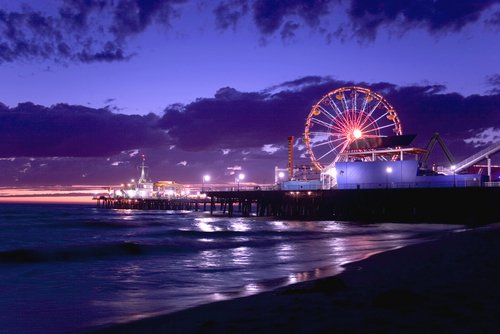
If you ask someone what the essential image of the California Dream is, you will most likely get a response that involves "sunny beaches". To this end, the Santa Monica Pier seems like the quintessential place for the California Dream. As a public space, the pier has done much to be inviting to the general populace as is evident by its history.


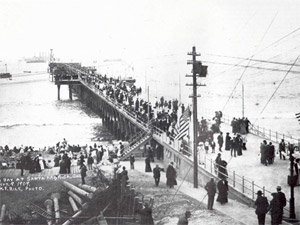
The pier was first opened to the public in 1909. Since its inception, the pier has undergone various transformations, such as the addition of an amusement park in 1916 and a yacht harbor in 1933 (for more information about the various additions / transformations, click here). What's interesting is that the property on which the pier was located was owned privately until it was sold to the city in the early 1970's. When the pier was in threat of being destroyed in favor of building a man-made island resort, the public responded with discontent, eventually causing the plans to be scrapped.

What I find interesting about this bit of history of Santa Monica Pier is the fact that the public felt so strongly about the issue of the resort that they were able to prevent the change from happening. Furthermore, it seems that the Pier has always striven to attract a wide range of people. That is, there doesn't appear to be discrimination against any specific ethnic group or class. From firsthand experience, as well as some reviews which I believe confirm my observation, I believe the pier is truly a public space - that it does not try to exclude any one group of people.

My opinions on the beach as a public space will change as I research more, but for now I would like to ask to any readers your opinions of Santa Monica Pier as a public space. Do you believe the space is truly welcoming to all? If not, why? Any sort of firsthand experiences of visiting the pier would also be appreciated!